Sunday, November 20, 2011

Changing roads to follow: start exploring

A new day started for me like almost every day starts at this time of the year. The sun is rising
while I drove in my car with music on the radio. I turned on the navigation system and selected a destination from my Favourites called “Work”. You might wonder why is work my favourite, well, at work, I’m involved with software testing and that is one of my favourite things to do.

Every day I follow the same route, actually I don’t need to use my navigation tool as I know where I’m going and which other options there are. Somehow I got used to it getting information which is sometimes valuable for me under certain conditions: the expected time of arrival. That information is also just valuable for a short period. On arrival only the arrival time remains and sometimes arguments for delay.

While driving along the route peeking at the navigation tool what the ETA could be. Also at my
dashboard of the car which is telling me that I’m not driving the maximum allowed speed. Triggered by this information I look with different eyes to the traffic in front of me. Although, different? The only observation I made at that moment was the same as I do in previous days following the same route. I confirmed what I already now: at this time the chance becoming part of traffic jams is obvious. So why bother, just enter the queue and lower your speed and accept
the conditions. Why bother for other information.
This day could be same as any other day. Following the route you already known, look at predefined” behaviour and at the end of the trip: report for duty. Only, this day was not the same as others. I observed that the traffic jam started earlier on the route then occasionally. At that moment I consulted my mobile app and got information about the length of the traffic jam, which was exceptional. I could accept the expected delay and use my navigation tool to monitor the ETA. The chance it would change beyond the boundary of 9 o’clock which would force me to escalate.

I could do what I supposed to do; follow a predefined path and collect information I already
could know. No new information collecting besides there was some disturbance which could cause delay. Making the comparison with scripted testing. Only collecting information about a certain path in the system (landscape) neglecting there are other ways to fulfil my trip. The obvious checks can be made:
- traffic jam = check
- delay within boundaries = Issue (assumption: queue is to long compared to speed and distance)
- option to enter the queue = check
- predefined route accessible = check
- predicted delay = actual delay = Issue (probably)
- accept delay = check
- predefined route followed = check

Again: following this route will provide me information about the accessibility of the route and the time it cost. It doesn’t provide me more information about possible routes which can be followed.
This day was different; I decided to take another route. I already had some information about one route which threatened the ETA: The Traffic Jam on the High Way. I changed my route. At first my navigation system told be to turn around and follow the initial route and based on this info calculating a new ETA. It took some denial of turn-message to get a new route to follow. Fortunately I new a bit of the area.

It seems like ignoring the original route. I see it more as finding a new way to reach my goal.
Immediately I noticed my new ETA was not increasing. It stayed as predicted. This can be translated that the new way to follow was not used at that point by others creating delay.
I cheered too early. Just after a while I noticed another traffic jam. This meant that other drivers
had made a similar observation. Based on my early experience I valued that this route would not bring me the expected result, being early, on time. Instead of adding the queue here I challenged myself by choosing other paths. This time I new just a bibt about the environment. I accepted that decisions I would made now need more information then just experience. It need focussed observations.

I still used my navigator in combination with the environment and my experience. As my
navigator tried to push me back on the high way I tried to ignore it and follow the road signs. A new information source was added to my journey. Just after a few minutes I relied on that new source of information, road signs in combination with small knowledge of the environment I followed and made a short stop. I did not feel good to go this direction.
My feeling and understanding about North, South, West and East I was travelling the correct
way, though I was forced to got directed to the road with the initial traffic jam. I made a bold step, ignore tools, ignore road signs with directions, I used my understanding of the position I needed to go to and the position I was at. At this moment I gathered new information: following this route could bring me back using another path.

I think it was this moment I got aware what I was doing. I was touring around, gathering all kinds
of information which normally would neglected. This seems to me the strength of exploratory testing, reject predefined paths, following your own, while doing reflecting the information you can collect.

I accepted that I can make decisions how to follow my way to destination point. I collected some
interesting information continuing.
- I came again on a road I know. It was also crowded by slow speed queued cars. The chance was that this queue caused the 2nd traffic jam I avoided. My mobile app told me that this queue was also huge.
- based on this information I choose another road combined with the position of the sun. The
ETA was still beyond borders. I saw a detour information board. I neglected it as it seems there might be other ways too. I interpreted it as a detour for other routes.
- A few kilometres ahead I saw traffic signs with places on it, this helped me define another road
which seemed to be more valuable while the navigator was telling me different. Somehow I could not rely on that tool as it wanted to direct me in opposite direction I was heading to.
- While driving I noticed I made some wrong decisions, followed the turn about by 180 degrees.
- I passed another detour which can cause delay
- I noticed it seemed I was lost in space and focussed on different ways, no longer the primary goal to get to the destination point, instead getting back on track again.
- trusting the road signs no longer heading for one known place I drove to a direction where any
place in the direction of my goal. I ignored feeling of being lost. I accepted there are multiple ways to get to destination as I was still in the right area.
- I came closer and got stopped by traffic lights. A new source of information normally neglected
by certain context. I placed it in future context. New knowledge was gained for future tours in this direction. I learned something new about areas.
- Finally I entered the town from a different view and could follow the last kilometres of the original tour. I did arrived within allowed time and learn more then I expected when I started

Lessons learned:
- Following pre-defined routes can make you blind for other information
- Starting to explore you need some bravery and embrace uncertainty
- Coping with uncertainty you need moments to defocus and to focus
- It can help if you don’t value information immediately, try to find the context and
challenge that context against another
- Exploration can bring you different information on different levels; perhaps it is not bad
and not good, if might even not useful after all
- Context can change; be aware and take time to allow it or not
- There is no wrong path, all paths provide new insight, it depends how to value it and
use it. Perhaps not immediately valuable, it might be in the future
- The meaning of situations causing delay change over time
- When exploring you can use more skills in different areas. Trust on yourselves and continue.
- Continuing parts of the original route is not falling back to it; it is addition of your
exploration.
- Even in daily live there are examples which can help you to understand exploring.

This day started good, normally I would complain about the traffic jams, now I got excited by the
lessons learned. I did something which was valuable for me. I was in control and learned. I made the decisions instead the predefined path in some kind of scripted route.

Saturday, November 5, 2011

No space for innovation?

This time a smaller note then usual. It came to my mind that in times of trouble we stick to what
we know. In history there were other cases when the world was in trouble leaders gave trust to those who got ideas which might fail or might succeed. For instance the war machine during the WWII provided in a very short time different innovations. (Technology during World WarII)

Perhaps the reason lies with the lack of procedures, methods and controlling processes.
After the war improvements were made which seemed to be successful for that time. People still using those methods and methodologies like PRINCE2, ITIL, BISL, TMAP, Six Sigma, etc. It helped managers to give them a feeling being in control.

Sometimes they still work for them. I’m wondering if there is still room for other approaches then people are looking for certainty and good practices are not yet given it to them. Is there still space in projects to approach uncertainty with Agile approaches? Can we SCRUM and accept the skills of dealing with that uncertainty and adapt earlier to get better results? Is a context driven approach in software testing explainable when managers are focussing on methods which are
know to them, instead of learning and adapting to the actual need?
I might be wrong, implementing methods can be useful, mostly I saw implementations of it where it became an objective on its own and no longer for adding value to business. Somehow I have the feeling that in times of trouble like we are now as in the economic crisis people tending to get proof that the method is working for them and make decisions to reveal that is not delivering the value by blaming it after all on the economic situation.

Is there space to use approaches like Agile approaches or Rapid Software Testing? Are there managers who dare to face uncertainty and learn from it, become stronger and more skilled? Search innovation in the way of thinking and working?

I hope so, as technology is still changing which mean that the way we have to face our new world might be different as we know. Although I’m uncertain about that too. :-) To maintain innovative we have to provide space for those new ideas also. Let us give and get some space for new ideas and try-outs

Saturday, September 24, 2011

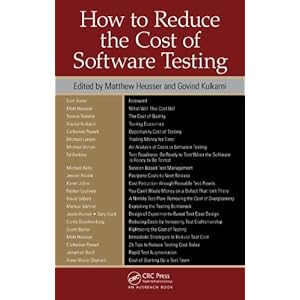
It is released! Book: How to reduce cost of software testing


This week this great book is released. (sept 15th 2011)

How to Reduce the Cost of Software Testing [Hardcover]

Not just another book
For me it is not just another book related to software testing. The editors Matthew Heusser and Govind Kulkarni gave me the opportunity to cooperate in their journey.

I think it is about a year ago an interesting thread started on Linkedin about cost of testing. This already made me more aware about this topic. There passed not much time Matt Heusser also contacted me as student of the “Miagi-Do School of Software Testing” and wrote me about Govind’s and his idea. He asked if I have some valuable contributions to make.

After explaining shortly to both that I was in the middle of some interesting exercise. Based on that exercise I might have some valuable contribution.

My short exercise
At that Time where I helped gaining information how we could help the business site of the organization by delivering software on defined dates while accepting in some cases functionality was not yet mature.
I observed that there was another need of information. I also noticed that which decision management made, it has impact on the test process.

When impact is involved, there are risks involved and to get more information about that risk you need to perform some activities. You can also introduce a risk yourselves: perhaps by not performing certain activities.

My idea is mainly based on controlling the test process on cost level by collecting information about the risks, the business need and how it work through the testing process. If risks are known you can start defining a strategy about how to continue: are you remain testing in the current phase and the costs are on that project? Or is there an option to shuffle the cost to another moment in time? Does it result in extra testing resources and cost or can you actually benefit from the accepted risks by management.

A year passed by
I never had experience writing a book or make a contribution to one. I had the dream of doing so. And more then a year ago I had the opportunity to participate. Amazing how such a process is evolving. I had great support from other co-authors and reviewers. They made me help to shape my story I believe is valuable. As I saw my story grow, I also had the opportunity to read the other chapters in the book. This strengthens me to believe we were working on something big. A book with combined knowledge and diversity in visions.

And now it is there! A book with great stories, sharing visions written and shared by testers I respect. If you want to know more about my contribution you might buy the book. If you have questions or need more information or share your experience you can contact me by mail.

Saturday, June 25, 2011

A day at Test Automation Day 2011

On June 23rd 2011 I was in the position to attend the Test Automation Day 2011 as an advantage since Squerist, the company I work for, was the founding partner of this event. In my profession I started with automated testing although I like to think more how test processes can contribute value to an organization I still have a weak spot for automated testing. This made me curious about what to expect.

I attended in the afternoon due to other obligations. This leaves me to the experiences of other people. I entered the exhibition area just before lunch and noticed the crowd entering the room. Normally I recognize some people from past conferences, now I saw new faces with one thing similar: passion for their profession.
I talked with a few of them and they heard new interesting stuff how certain tools might fit into their business. They got already some value back for attending. Others heard more or less the same story. Isn't it always this way.

I attended 3 keynotes: From Martin Gijssen (De kracht van open source testtools), to Mark Fewster (Experience Driven Test Automation) and Scott Barber
(Automating Performance Tests: Tips to Maximize Value and Minimize Effort)

Somehow I missed another presentation in the middle. instead I had a great talk with others.

What I remembered about the presentation was that Martin was able to speak about open source tools without making a judgment what we should do. In generally it depends, sometimes open source tools are good to use, sometimes not. Personally I expected more information how, when and the pitfalls instead focusing on a framework. Though some introduction was needed and if time is valuable you cannot tell the whole story. What left was the importance of a framework, a test architecture and key-word driven testing is still kept alive.

About Mark Fewster: I like this guy, If you sit far behind in the room and you don't have the full picture he has some similarity with David Letterman only in his best days. (hope he is not offended by this. I enjoyed listening and watching to him) With passion and wit he stood there convincing about the experiences he collected about test automation. Based on this he shared us his future. One of the things in his future was the maturity of tools supporting test techniques. I think he might be right, there will be coming more tools than ever.
I think another road in the future is the need for focus of tools on the human aspects.

So I think we have here 2 paths: 1 path of tools which will support more techniques and move towards the developer to build the scripts for testing and other tools which will support the "keyusers" to tell in what they want to do or did with testing.
What the future will bring, we will never know. At least he triggered me to look forward to his book in which he collected the experiences of others.

The last keynote was provided by Scott Barber, I never saw him before. Wow, he is an artist, how he sells his story. He got me all the way. Although it was mainly focused on performance testing, he sold me the idea that it is quite different then functional testing. More complex. And perhaps equally fun :-)
During the time he gave us 10 tips for free to focus on while setting up your performance test. I think they also are generally usable for all the test we perform

Top 10 performance test tips by Scott Barber on Twitter
10 data design
9 variance
8 object orientation
7 Iteration/agile
6 Error detection
5 Human validation
4 Model production
3 Reverse validation
2 Tool driven design
1 value first

For details about his tips, just contact him. I'm still looking forward for his presentation as the information was to much to write down. And he has some story to tell. (Afterwards I spoke with him and he is willing to tell you about his experiences)

Some of the eye-openers/lessons I remembered:
1. Performance testing is for developers, let them help you,
2. provide information about performance on continue basis, not only as a big bang
3. Think about the release management, test management and infrastructure before you start measuring performance
4. Also in performance testing, numbers doesn't say much. Perhaps start presenting you measurements with the happy faces and sad faces.
5. Although I was not directly involved with performance testing, in the past indirectly I learned some items and were involved with some performance issues too.


I think this conference was a good one, for a first time I think they can be proud of it. A lot of information was shared, good presentations (and some less) were given. They missed the short break after the 2 keynotes and between the "business cases". Now there was less room to share experiences of the presentations. As all conferences, you hear some old wine in new bags or what is it called. I strongly believe in the skill to learn from the information you get and read between the lines.
I had some good fun that day and was surprised. It triggered my thoughts and extended some perceptions/views and ideas.

Friday, June 24, 2011

Reflection of a day at DEWT

DEWT peer conference: A fact
On June 11th 2011 the first #DEWT peer conference was held. For passionate testers attended by passionate tester and challenged by the same testers. The intention of this day was to share information about topics we have chosen in a previous DEWT meeting with the understanding it interest us and might help us understanding better and become better testers.
Next to sharing information it was also an opportunity to practise some skills like presentation and teaching. Or what about sharing ideas to work on them.

The evening before
Actually, it started already the evening before. In an informal setting, more informal then on the 11th we sat down at the bar and immediately the spirit was already there. The spirit of supporting and challenging each other, tell about their experiences and how we might continue.


This was just at the beginning of the evening, there was much fun from sharing experience stories, judging the music, talking about artists and how lucky we are the have open minds able to learn what is testing all about.

The day it happened
At 9 o'clock sharp we started.....with waiting when the last persons would show up. And after 10 minutes the great happening was opened by Ruud Cox, appointed chairmen for the first part of the day. On a previous meeting of DEWT we decided to support this day with 2 chairmen (Also Jeanne Hofmans) to restrict our ideas and thoughts. Based on the same session we came up with the following program (except the lightning talks, those were defined during this day)

On todays program where the following topics:
§ Opening presentation on Artful Testing by Zeger van Hese
§ Transpection by Michael Bolton
§ Lightning talks by:
Jeroen Rosink: Testing Pyramid
Huib Schoots: The power of knowing nothing
Zeger van Hesse: Bader Meinhoff-phenomenon:
§ RST and SBTM in The Netherlands by Ray Oei
§ Credibility (the quality of being trusted and believed) introduction by Ruud Cox

Each performance had its own perspective and story, you had to be there if you had the chance.
I shall not recapitulate everything instead let me tell you some of the lessons I learned

Some Lessons Learned
When Zeger told about art and artist he made the relationship with testing. What I liked is that he sees testing as and art though we are not the artist. Testers can be seen more in the role of an art critic. And an art critic should know about all the variants of art.
Should he?
This triggered me thinking about the tester, should he also be aware about all the variants of testing? Perhaps at a certain moment. At least what he knows about testing must be told with confidence en compared to the truth.

I think if you keep shouting something is bad, that noise will no longer leave your room. If you tell the story and you are capable to make that story accepted then you gained reliability. This means you have to be able to explain in certain details what your test was all about....You have to be able to tell and explain the art of the software.

Another challenging topic was supported by Michael Bolton and was about transpection.

What I remember about the definition was Transpection: "An idea in head to explore which gives the person the opportunity to probe/play with the idea without influenced too much"

Valuable information about this topic can be found on:
Transpective Dialogs for Learning
by James Bach

Blog: Transpection and the Three Elements of Checking by Michel Bolton
Blog: Transpection and the Three Elements of Checking by Michael Bolton

He challenged us to use transpection to investigate the meaning of it. it made us think. Some investigated the internet to find more information, or examples. Together with Jean-Paul we did our own mind exploring to see how we would see the boundaries of transpection.

What I learned about transpection it is already done by persons like Plato...it is a good way to gain information or guide persons to learn/gain insights. Not everything is a transpection, pub talk can be rather not. It has a beginning and an ending although you never know which direction it goes. Though it starts with a main subject.

I think transpections can change over the time. With this I mean:
- you are the person who held the transpection and challenge the other
- you are the person who is challenged
- During the initial transpection, in which you are challenging your idea, you leave space for the other for a moment of transpection. perhaps you get it back later on?

Some questions I still have:
What is the option to step out of a transpection?
How can you step out without minimizing the result for the other?( Rude behaviour might distract and loose focus on the results)
Can the main subject be changed? How is this done/monitored?
When do you have a transpection and when did you loose the transpection?

These are some questions I have to look further and learn about myself.

The Lightning talks
The first talk was provided by Huib Schoots. He explained the idea of the power of knowing nothing. I think he is onto something. Though I know a bit about this :-)
It reminded me about the concept by general Rumsfeld: about known-knowns onto the unknown-unkowns.
If there is some power behind the information we don't know I think it can be worth to investigate what we don't know and always be aware of it.

I was also chalenged to held a talk. This gave me the opportunity to challenge an idea. While expressing the concept I was triggered to continue thinking about it. What was my idea? The main concept is that testers start as junior and grow up as senior. Only there is not much space for seniors so if you want to survive, you ahve to be good at what you are. This reminded my about a story by Adam Coucher: The most important stakeholder are you!

Or what Cem Kaner ask us: do we want to be commodity (a banana)Exploratory Test Automation: Investment Modeling as an Example by Cem kaner or do we challenge ourselves and learn?

In my opionion if you want to stay in business you have to create to ability to learn and not only to remember. You have to be aware that you can't rely on what you have done in the past or which certificates you collected. You have to be aware and think what you want to be.

During the lightning talk MB chalenged me: about the "You" and the "Why" he was right. Who am I to tell you what to do!!!

Zeger spoke about the Bader-meinhof-phenomenon. If I'm correct it is about the situation, when you noticed something strongly you suddently see it all around you. Imagine you have a new car, before you never noticed those beautifull cars, and now it is all around you. Imagine what this can do with bugs. You never were aware of this type of bugs and now: HELP!!!!

The thing I don't like is the title of this phenomenon, it has some negative feeling. Im certain there are other sources from psychology which explains more in detail from another perspective about it. I know that something similar is also explained by Oliver Sacks in The Man Who Mistook His Wife for a Hat
In one of the chapters he explains about a situation where after learning about it he saw similar symtoms all over the city by people.


Somehow we made it to lunch and deserved also a great walk through the woods next to the hotel.


RST in The Netherlands


After getting back some final tutorials were given by Ray Oei who explained about the lessons he learned implementing RST at 3 companies. It was sometimes hard as we still live in "TMap-country" There was some sound who explained that if TMap is asked we might call it TMap.


This idea I reject. Why call it something which doesn't work in the essence because when we ask testers about it they too often exlpain that it is not done as written therefore intended. They made there own twist..When asking them about it it is far from TMap. They use some templates, they use some techniques, they use some something and at least: it is al planned and those planned are nto telling what you actually did.


What I believe is: if you found you own way to make testing happen, don't lean on a name to sell it. By selling it under a name like TMap or ISTQB you support the believe it actually works. So it is sold more often. Perhaps it works for you, what I believe in is in honesty. Borrowing good things or bad things from a concept which leads to your succes doesn't make the concept be a succes.


Ray remined me why I suport RST because it chalenge you to think out of the box, it helps you to guide your thoughts, it leaves space to make it work for you!


Are you credible?


After the RST the final presentation was provided by Ruud about credibility of a tester. he is onto something, we testers should be aware about our credibility more often. When it is gone it is hard to gain back. Perhaps we should copy his action and create our own card or "buy" it from Ruud


copyright about the photo: at Zeger van Hesse/ copyright of the actual object (style-card): at Ruud Cox

    STYLE

  • Safety language

  • Two ears one mouth

  • Yes but

  • Lighten up a little

  • Empathy


With this final tutorial we closed the day in STYLE and went out for a dinner and reflect on the day and share some mysteries and parrots ;-)


Afteral it was a great day.

See also
DEWT
Zeger van Hesse
Jean-Paul Varwijk

Monday, June 6, 2011

How can I work when you build a fence around it?

Protection of your work
Last week while I was busy with one of my hobbies "geocaching" I found beside the treasure another particular thing. As on the photo below you see a mailbox only how can the postman deliver his work?


You might pass by this situation and laugh about it and continue what you are doing. The same you can do with this posting. You also might think what can be learned from this? is this a bug? Can it bugging me? Or bugging someone else? In certain situations I try to reflect on these situations towards testing. I believe that in every thing/situation there is something to learn from and which can help you define your mind set about testing.


A mailbox as trigger for questioning
So what did this picture triggered me: translate mailbox as you test object...it is a box that you want to see what you can do with it, what value it can give you, what you can tell about it, perhaps you want to take a look inside.

Currently there is a fence between you and the mailbox. How would you translate the fence. In my opinion anything which stands behind you and what you want to do. This can be procedures, a process, no resources just use your imagination.

The situation here reveals more information. Only you have to make assumptions, and some people claim making assumptions is a bad thing for testers. I like to play with assumptions to see if there is valuable information behind those assumptions. For this situation I raise the assumption that this mailbox was of use for someone at some time for some period. I'm onlyy a person who found about this situation when there was a fence. Perhaps this was not always the case. This is an assumption. In my opinion the value of the object changed over time. Only it is the value I can give based on my current observations and knowledge. I might tell this mailbox cannot be used anymore, big deal, the postman should take postcards back to the station.


Change of process
For the postmen it might disturb the process as he was ask to deliver, by taking back it is not taking back his postcards; it are the receivers postcards, and now there is no line of communication with the receiver. The package cannot be delivered and there is no solid way to communicate about the changed situation. The owner was not available. The fence is stopping him to do his job.


Another assumption here is that someone else placed the fence for some reasons we don't understand, yet? That other person used his process to place the fence without bothering other process which affects his action. In organizations there are also those people/roles. Therefore this can also be translated testing.

Other processes affects testing

How often are we testers bothered with other processes which stopped us doing our job? Our job is testing, asking questions to the software and more. How often are we busy to find information why processes/procedures which are defined to help us obviously to test better? Making the quality of the process visible instead of making the quality visible of the product. We use our energy on other "important" things than using it for testing. I learned that often we are busy with "valuable" metrics to control processes instead of collecting information to tell the story about the product. Value time is lost.

Help us with testing

Instead of focus only on processes try to focus on testing. Sure there is always other processes which affects our work. Let those processes help us. Only make sure you don't build your fence around our job!

Monday, May 16, 2011

Testframing: a bit of my perspective

Last week I attended a tutorial on testnet spring event 2011 given by Michael Bolton on Testframing. I already read something about (see: http://www.developsense.com/blog/2010/09/test-framing/ )and now had the chance to see it work. it was a great day as it made me think more about this concept. To preserve my thoughts and ideas I wrote this article. Perhaps you can learn also a bit from it.

Initially I thought it would be an approach were you frame all the tests in constructive sentences, and write them down. So initially it seems to be the same as I was told to do in the past: write test cases and then execute them.

I was wrong then: Why would you write down or use valuable time to write down test cases till the lowest detail when your mind is able to work with the speed of thinking. So there must be more to understand.

During the tutorial I noticed that one of the strength is the way you use a mission to guide the story you want to tell and the observations and actions you do how the story can be told. While explaining there was interaction between the listeners, when something was not clear you change the vocabulary of the proposition or perhaps the vocabulary itself. You even extend the frame using formal or informal connectives

I think that the difference between writing test cases and test framing it takes you much further, it combines the strength of a test strategy with thinking about the justification of testing together with(when necessary real time) adaptation of the path in the system you tending to follow ending up with the explanation of the results you found combined with the justification why you did it. This can be done very fast.

In other approaches like TMap we tend to call it in the Netherlands, there are all kind of delays involved, first the plan, then the written cases, then the execution and after a while a verdict about quality which was stated in the plan.
In some way it is a structured way of working, is it testing? This is another discussion I will not start here. There are other sources about this topic.

In short I learned more about test framing that it is a way of telling a story why and how you tested something combined with the results you found and what you think it tells about the system.
Testframing to me can be done by writing it down, in some cases this makes sense perhaps because of some complexity is involved or some kind of uncertainty about the system you have and you use it to validate your story.
Sometimes you actions are less important and easy to explain afterwards, then you use it without writing it down, just explain it.

Somehow I see a lot of potential in this way of testing. one of the reasons is that it keeps me thinking if I'm doing the right things.

On the same day Michael Bolton also had a keynote were he explained about the dark and the bright future. This was a great view. In the birghter view he explained about first order measurements (some more information can be read at stickyminds.com:
Three Kinds of Measurement and Two Ways to Use Them By Michael Bolton

While explaining first-order-measurement he used a connective "or" this triggered me to think that this is one of the strengths of testframing. You are able to adapt you story based on the first-order-measurements. My first reaction was: This is great!

If I'm able to tell a story about why I'm doing something with what mission (direction) then I'm able to tell the stakeholder/person who cares why Im worth paying for and spending time and resources.
If I'm able to make visible that I'm able to react on circumstances, the information from first-order-measurements, which are happening now instead which happens in the past (the delay when test scripts are written down and the explanation is proved later on) then I provide my self a tool to see if Im on the right way of acting and providing information which are accurate and supports transparency.

Looking back to testframing, I see some different ways to use it with respect to logging the actions:
- use it by thinking in testframing: nothing to write down or explained.
- use it only using your mind, thinking about it and explaining what you have done/doing
- use it in front and write down some notes how you think you want to approach the system
- write down while testing how you framed the mission
- pair testframing: you tell and share your thoughts/mind and another person make notes without interrupting you thinking process (this is another role than the person who challenge you while testing)

Another dimension here is the measurement-order. I think first-order-measurement is an valuable addition to be aware of while framing. Here you can do also some logging as the measurements changed or confirmed the path you were following in your mind.
- before testing and framing first: you might consider which propositions might provide valuable information
- during framing and not logging the testframe itself: log the moment of measurement and result, here you might wonder if you also write down the impact on your story.
- during testframing and also explaining the result: tell the story not only what you have found and why you did it, also explain what impact the measurement had on your frame and ask if you valued your measurements properly. If not there might be some valuable information left behind the framed story.

Somehow I believe testframing is a great way to test a system fast with the right transparency and justification. it is not just a trick you can learn, you have to practice to be able to do it and learn to become better at it. It is a way of thinking and communicating with others which is not only challenge the system as you do it, it also challenge you by explaining how you do it. Perhaps it also tells the story about the tester.

I hope this article challenge you to think a bit on Testframing, for me this is just the beginning in learning about testframing looking for opportunities and time to start with it and learning about it.

Thursday, March 3, 2011

Issue solving in the cloud

This time not a story which I did a bit of research. This time not a long story, at least the intention is not to write one. This time about a thought I want to share with you.

The trigger for this thought was the failure of internet. As often I didn’t had the phone number available to call some service desk. Therefore I used my mobile and twitter account to express some #fail moment using a #service from some #provider

Within 10 minutes I got response from a service desk who noticed my call and asked for more info over twitter. Wow, I was taken serious, even more serious then providers took me before. They came to me to help me instead I asked them to help.

I provided some info with the idea: “We will see, perhaps it might work for me.”
Approximate 15 minutes later they came with the information that there was some kind of capacity shortage and they are working on it and asked me to have some patient.

Wow, not only they contacted me, they also shared information with me. How powerful twitter can be.
I shouted in the cloud and got help from some kind of desk. This made me think about the concept: “Issue solving in the cloud.”

Imagine that all apps, information, data etc are in the cloud. As user the chance of identification the service who can help me might even more challenging then solving the problem. Nowadays if we have an issue, we make a ticket or call someone to make a ticket and we have to wait and see. If I don’t know who to contact, why not make the provider responsible to monitor. We just need some rules, or perhaps even not. Who will tell.

Assume the following
- I want help
- I don’t know exactly who should help me
- apps are every where and nowhere, at least I don’t know were
- I have a tool which I can use to communicate

If there are a huge number of applications, you can do several things, use several issue tracking systems, (how can I monitor all?) Buy some service who does this for you (why do I need to pay more for something I don’t control?) or just communicate about it and use only those apps of organizations who also care.

Perhaps this can twitter also be for us. In this example I know what was not working for me I used the identifier #fail and a #provider name. Surprisingly, someone cared and responded; and informed me.

Perhaps this is the new way of issue solving, not writing huge reports what went wrong (only 140 characters) get help by interaction (question within time) taken seriously as a customer (provide service). No issue tracking list about metrics, no waste of time by spending more attention how to get the numbers right for management instead use that same time to investigate, learn, question and adapt.

I know this might be far away from the future how to deal with issues and provide service in the cloud. In my opinion if cloud is a new way of serving then also problem solving must be adapted to the this new way of working. Let change the roles. As we placed the apps in the cloud, the data in the cloud and the people in the cloud. The not store the issues on the ground and use the processes for solving as we do know. It might not fit. So let look fore other solutions out side the box into the cloud.

Just a few thoughts about issue solving in the cloud to share with you.

Monday, January 31, 2011

Seminar: Are you innovating

Although this is not a correct translation it might make things more clear then call it "Innoveer jij mee!"

Today I attended a free seminar sponsored by Ordina with to great speakers: Gojko Adzic @gojkoadzic en Anko Tijman @Agiletesternl

The evening started with a long row to obtain "bad" coffee. With this start everything can only improve. And it did. Sure, there are always some things which are worse or could be better. Let me start with some small notes about the impression I gained. It is not the full story, just some snap shots and ideas.

Gojko's "Sleeping with the enemy".
As the chairmen mentioned, "Oh, no, not that again" It was not about testers and developers. Us and them. Hearing Gojko mentioned these words I immediately thought about the song from Pink Floyd Us and Them

Looking to the lyrics it can be so true. It also start with:
"Us and Them
And after all we're only ordinary men"


Gojko did not emphasize the idea of Us and Them. What I remembered was that he want to skip the functions. In teams we don't need functions, we perhaps need roles. We should get rid of our who's to blame culture.

He started with a great statement "Why are we[programmers] going to stop telling testers how to do their job? They know testing much better than we do!"
There is still some discussion possible if developers should test or testers should test. I think we should do both. I will come back to this later on.

In my opinion he used a very strong example. (Keep in mind that these are some pieces I remember from this evening. Therefore these are my interpretation and words).
A driving instructor is not telling you: you hit that car, and that car and that pedestrian. A driving instructor is teaching you how to drive.

A similar thing we testers should also do. Teach the developers how to test, participate. If they are able to do the testing for you. You gained time to do more important things.

Meanwhile @michelkraaij tweeted a statement @gojkoadzic, you keep making the distinction between developers and testers. Testers ARE developers!

We discussed this in the short break and Gojko marked that within a role there is also persons are involved. I translated that into a thought that personality is also important how a person can interact within his role.

So I polluted the twitter sphere with this idea as response:
ppl matters,personal value creates personality help define skills 2 form attitude able to act in a role

My idea with this statement is that it is easy to think that every one should be able to test or develop or do the same. Skills should be equal. Who does is doesn't matter. If people are involved we should respect them and human beings with a certain value. People differ and therefore have different personalities. I think the personality able a person to use their values under certain circumstances which will express their skills under those conditions. When it is noticed, people will respond on it and this will influence their attitude. And now based on the attitude, the presentation of the role which is needed will be express also. (don't shoot me for these thought, it are just ideas which seems reasonable to me, I did not read a book to support these ideas)

As promised, based on this concept it should not either be developers or testers who do the testing. Testing should be done by those who care about testing. If a developer cares about testing then let him test.

This was in other words also Gojko thought; he explained that when testers were involved quality reduced as they rely on the tester and no longer on their own skills/value (testing).

After all Gojko held a great presentation with hand drawn slides :) With perhaps a credo: "let developers help us to test so the testers can do other important things."

I think this can also be expressed by the words from Pink Floyd from the song mentioned earlier "And who'll deny that's what the fightings all about
Get out of the way, it's a busy day"


Agility in the waterfall?
After dinner Anko started the presentation he also held at Eurostar 2011 called "Building a Quality Driven Team". After some introduction he came up with some slides I initially thought he wants to bring us back into the waterfall. I can come up with argument I reject his story. I think he showed me some other ideas concepts. He made me think. Although his slides seemed to look like waterfall explanations. If I turn that concept around: He made me able to bring put arguments to the traditional project manager who relies on requirement, design build etc till it is good and supported by waterfalls ect.


The model Anko made for me was a model I could use to explain how certain phases of Agile testing fits in a V-model approach. If a PM fancies a V-model, why not use it to explain your thought. It can help to express that your ideas about Agile attitude and quality firs in his project also, only there are some other conditions. You might be able to build a bridge between different thoughts and gain some understanding. This might be a solid base for obtaining commitment.

Anko posed another statement about the emotional acceptance factor. I would translate that into an example I learned a few years ago.

I was on a project with the ideas of Agile and with a lot of commitment from business, team and project management. We tested together and did a great job. As well as developers and testers were able to tell on daily basis what they did and how the project was evolving and value was introduced. We were almost finished and one of the stakeholders complimented us with the result and made one final addition. I see you did a great job, I see that the quality is somehow made visible. The only thing I would ask you to do: Coach and support one of my key-users, make him test in his uncoventional way. if you are able to help him gain trust it would help me to sell it to the business.

This was not about not trusting our results. This was about some feeling based on emotions. This was emotional acceptance.

Hearing those words, I start remembering more of those examples. It is not explicitly written in books. It is there. And we should care.

There are more things I have remembered and should remember. After all, it was a valuable spend evening. Of such value I want to share it with you.
At the end I had some great conversations with other people and thanked Anko and Gojko.
While driving home I forgot to ask him if he had a copy of his book available and ready to sign, perhaps another time (@gojkoadzic you have my card :-) )

Wednesday, January 19, 2011

Navigation by blindness

Let me start again with a phrase: a few weeks ago.... some how I got triggered by the navigation system I own. I drove back from work towards the place I call home. I push automatically the “home” button and the navigation system calculated the optimal trip home without asking me for any questions if I prefer another way to follow.

Normally I would consider this normal behaviour and follow the advice route or ignore it. This time I got aware of “it”. “It” gained is this situation a new context. “It” turned from an accepted situation of which the rules did not matter into a situation with several conditions. “It” turned into a predefined path into an path which could be overruled with made decisions which I controlled.

You might think, this is nothing strange, you always follow the route which is calculated, or you also overrule the calculated route.
If so, are you able to make the connection with software testing? Do you even wonder if there are connections?

At that moment driving back at home there were several things I thought of:
- Why do I ask for a defined route calculation although I know were I am, were to go and how to drive?
- Why did I still continue to add the destination?
- Why was I curious about the ETA, I had a watch and I know how long it would take approximately and somehow it was not higher maths?
- Why did this remind me of some moments in regression testing? Performing the same actions although you know the outcome?
- Why did it give me a bad feeling that using a tool did not provide me any additional value?
- Why did it feel as false trust to rely on a tool although I could use my own knowledge, skills and senses?
- Why did it look like I was in control and in testing using standard regressions test or standard automated tests provide same feeling of control?

So why do I bother at all to write about such a simple action. That is “Why”.

While driving I deliberately ignore the advice as I know another route, not faster, not slower, a route which worked for me. I ignore the tool, the navigator, and followed my route. I used a who-cares-factor.
So who cares?
I cared because:
- I got aware that I was able to overrule the system
- I got triggered to ask me the question why to ignore the system
- I added new value to the meaning of the route, as I was curious about some parts of the area
- It made me also challenge the tool I was asking for information. I compared the initial prediction of ETA combined with KM’s to drive with the newly forecasted information
- It made me able to listen to my car under other conditions, instead of driving 80 km/h driving the care with 120 km/h. somehow certain speed at certain moments gave some other thrills.
- I got aware of a situation were things seems so obvious you have to change focus to learn new things and redefine old behaviour.

That evening I learned more about not following blind advises provided by people or systems. I learned to play with the context, instead of accepting the situation I got new insights about the way I behave, think and act. I learned that I and perhaps others using tools out of familiarity instead of certain purpose which value has changed.
I learned that if you don’t change the situation or circumstances then the value will be minimized. This remembered me of a lessons I read somewhere sometime that if you don’t change your regression tests then they are worthless, they don’t add anything. So why do it, spend time, and valuable skills if you skilled testers?

I think we should avoid navigate with certain blindness by relying on tools and defined routes. Instead we should change our test cases and not rely on our “old” regressions tests or other tests we scripted in the past.

Thursday, August 12, 2010

Geocaching and software testing

Introduction
A few months ago I was introduced by a friend of mine with the phenomenon called Geocaching. Looking at the title of the Geocaching site "The Official Global GPS Cache Hunt Site" you notice the word "Hunt". To me this seems a bit like testing; as testers we are hunting for bugs instead of caches. Below you will find a short introduction to GeoCaching, for more information check out one of the links.

A short introduction to GeoCaching
The definition about geocaching on the main site is: "Geocaching is a high-tech treasure hunting game played throughout the world by adventure seekers equipped with GPS devices. The basic idea is to locate hidden containers, called geocaches, outdoors and then share your experiences online"

I highlighted a few words which have some similarities also with software testing:

High-tech treasure hunting <> in an high tech environment searching for bugs
adventure seekers <> passionate testers
equipped <> with tools and skills
locate hidden containers <> identify issues
share experiences <> share value of the tester/system

You might find more similarities in this definition or you might believe these are not the similarities. You might by right. In my opinion are more relations between testing which goes further then just looking at the definition.

Recently you see testers I value bringing up all kinds of challenges. Challenges to make the tester think. Most of the time those are directly related to testing like the missions in http://weekendtesting.com/.

Geocaching brings you also this challenge, only not just behind the pc, it takes you in the world outside, the caches are most of the time outdoors (Yes, there are some also located behind doors when you search for example in the centre of Amsterdam on caches)

Besides the official geocaching site you can also take a look at the wiki page: http://en.wikipedia.org/wiki/Geocaching

Type of caches
There are several types of caches with all their own purpose and symbols (depending on site and/or tool). Below you see a selection of
Traditional: The basic cache type, a traditional cache must include a log book of some sort
Multi-cache: This variation consists of multiple discoveries of one or more intermediate points containing the coordinates for the next stage; the final stage contains the log book and trade items
Mystery/puzzle: This cache requires one to discover information or solve a puzzle to find the cache
Virtual: Caches of this nature are coordinates for a location that does not contain the traditional box, log book, or trade items
Earthcache: A type of virtual-cache which is maintained by the Geological Society of America. The cacher usually has to perform a task which teaches him/her an educational lesson about the earth science of the cache area
Event Cache: This is a gathering organized and attended by geocachers.

Types of containers
There are several types of containers which contain the logrol. They are from magnetic to nano. from mini to ammo-boxes. Depending on size the purpose is defined and value can be added.
Example of a nano-container


Example of a ammo-box


Example of a re-using containers (foto-container)

An example of a cache hidden behind a location you normaly wont look


A great example of a container can be watched
http://www.youtube.com/watch?v=Lu7IysgaZf8

Coins and travel bugs
When you found a cache, depending on the size it might contain valuable. For some the valuables are trackable like geocoins and travelbugs. For others they are just playable valuables (kids like those stuff, we don't value any more, thought kids have a new toy to play with)

Travelbugs and geocoins have the behaviour to travel around. Sometimes with a preset goal and sometimes just with the goal to travel as much as possible.

There are several ways of selecting your caches.

Some similarities in caching/testing
Similarity 1: Save environment
I started with selecting caches in the neighbourhood. It feels save when you are in your own environment. Like testing you try to start testing in an environment you know, which gives you a save feeling.
Example of caches in my environment at a certain time


Similarity 2: Learn from environment
During my search in my environment I noticed the different levels of difficulty, terrain and also types of caches. Initially the traditionals were easy, then we started to act as a team (family) and walked a multi-cache in our neighbourhood. We joined our effort and watched and learned during the walk.
During testing you have to look further then just your cases. learn from your system/environment.

Similarity 3: Remember patterns/hide outs
While finding traditionals and exploring multi-caches we trained ourselves to identify the types of containers which contains information or the actual caches. In testing you will also learn about the hide-outs of bugs. For example: This can be based on the technology which is used or the process which is involved. You recognize situations.

Example cache hidden in fence. notice that it is under a lit, (you have to look beyond the black box-vision)


Similarity 4: Touring
While I was already active for some weeks I made some trips to my assignment and also to family. before I went to those location I planned my tripped, reserved some additional time to enable myself to search some caches. Sometimes it were short tours picking up just one cache during the route. Other times it were large tours, planning multiple pick-ups during the travel to the north. For this I used the map from geocaching.com to identify possible caches.
Like in testing, you plan and schedule you tour within a certain context.

Example of a map of a long tour (Defocusing)


Similarity 5: Challenges
Like said before, there also mystery caches. These involves some homework. Before you are able to find the cache you have to solve puzzles to calculate the coordinates. You have these also in different types of difficulties. Sometimes you can use the internet for it searching for answers. Sometimes you have to try to think different. This can be challenging, you have to focus and defocus finding the answers. Sometimes you are not able to find an approach to start. Either you leave this cache and continue with another or you ask for help. In testing we also facing challenges which we are not able to solve immediately. it is from these mysteries you learn the most.

Example of a mystery to solve


Example of another mystery to solve


Similarity 6: Pair caching
Recently I cached with a friend of mine. We scheduled a route to pick up as much as caches within a certain time frame. The preparation consisted out a list of caches we wanted to find and some spare caches. We created a tour plan and drove away. With 2 navigation and 2 GPS devices and internet connection we started the day. While caching we noticed that we could be more productive if we split up tasks. Instead of single logging caches etc we came up with an approach where drove the car, while driving he entered the new coordinates and made some pre-work. At the location we both searched for the cache. When it took more then 10 minutes we used both GPS devices. when found, the friend logged the cache in our administration and I on the cachelog. While hiding he entered the next coordinates and we drove of. We managed to adapt our way of working during our mission.
Like in testing we can benefit from pairing up.

Example Preparing a short tour with several types which fits in time frame


Similarity 7: Collecting information and Registration
There are several things to register and collect. I started to print out all the caches I hunted for. On those printouts I wrote down the date, time and nr of cache found. Just for administrative purposes. When needed I also add answers to questions in the cache or the newly calculated coordinates. This is fine when you are acting in small numbers. Now I learned that storing that information takes space, it takes time and sometimes it is not valuable at all. For instance the caches which are just for picking up. Why store that information also offline while it is online available also. it is available on the spot you found out about the cache: geocaching.com

Example of using other techniques


As learned in testing, I learned that registration should be of some value. Sometimes information is needed for an undefined period, sometimes you can delete it when it is used. For example: when a cache is found and no one needs my information, why keep collecting it.
At least I register the found and the not found on the official geocaching site.
There is some value in collecting information when you solved a puzzle and the way you solved it can be usable for other mysteries in the future.
In testing we do the same: we collect information and we register information. And we also do this too much. A lesson I learned again is to collect just information which contributes to the value of the object/system/person

Similarity 8: Find and learn about new spots in the environment
One thing I like about caching is learning about new locations, I was often surprised about the beautiful nature just around the corner. I get a broader vision about my environment were I live in. Also I identify suspicious bricks etc. on locations it is not their nature. Sometimes you see them everywhere. Currently for me there might be caches behind it when I am aware of a possible location in that area. There is the thin border about known known's and the unknown unknowns. You can explore and take the effort to look below the suspicious brick. You also can save the energy.
In testing it is the same: while testing you learn about new spots in the system. You might see suspicious actions in the system. Sometime you focus on them or you leave them as is.
Example of a cache hide-out in a tree


Similarity 9: Valuing your findings
As mentioned before, caches can contain some values like travelbugs or geocoins. You can select caches based on the probably chance of containing those items as mentioned on the website. You know it is there if you spot it in the cache. Sometimes some other person already found it and took it with him.
When you found an item you can decide if you take it with you and register it as taken, or you leave it and register it as discovered. When you decide to take it, be aware that those items might have their own goal, and sometimes that goal is attached to the item, sometimes you have to read it on the website. be careful to take it when you didn't check the goal, you might disturb the purpose of the item and disrespect the owner.

I found this also in testing. Sometimes you check the existence of value in a system based on some information you have. Sometimes you spot items which you were not aware of. you have to be careful if you call it a bug or an issue. Sometimes you were looking for it and sometimes it is not reproducible.

Similarity 10: Addictive
Geocaching is addictive. I enjoy solving puzzles, walking in other environments, spot those caches. Learn other techniques.
This is what I also gain from testing. I like to test, learn about applications, learn from other people. I want to keep testing.

Conclusion
There are similarities in testing and geocaching, in both you tour around an environment where you gain knowledge if you are open for it. You get pleasure if you enjoy it. You have to approach systems/environments and people with respect.
There are always other approaches which you can learn even after asking for help which guides you kin the future.
One of the valuable lessons here is that you have to spend time and energy to make it your own. (often registration is free and there are no certification programs)

Wednesday, July 28, 2010

Repsonse: on How many test cases by James Christie

Somehow the question about how many test cases is so important for "important" people. As if they are getting paid by numbers instead of valued for delivered value. Somehow a false trust is derived from figures. People rely on numbers and assume that number of test cases represents good quality. This seems so obvious the way of doing.

The posting of James Christie triggered me to answer using my weblog.

I value the blog posting of But how many test cases? written by James Christie by its content in relation with his defined context. This context is lost when you translate it to numbers. Below you will find several attempt to make a good posting valued wrong.

Example 1:
Imagine that your blog posting is rated by the number of letters. In your posting you use about 5534 characters. Telling the same story using twitter you need over 40 tweets. Does this show value? It seems that one post in a blog provide more value then one tweet, although the tweet which pointed me to that blog was also very valuable. So is 1 more then 40?

Example 2:
Or what about the coverage of letters. You used all letters of the alphabet, this means your coverage is 100%, does this provide some information about the quality of your posting?What about assigning numbers to it?


Impressive usage of the letter “e” based on numbers it is far most the extensive used letter. Does this provide information? I don’t think so, Perhaps the letter “e” should be used more often, perhaps in relation with other letters. Even this way of thinking is wrong. It doesn’t tell any thing about the context.

Example 3:
What about visualizing the numbers. Below you see a snap shot I you look only at the numbers mentioned in his blog.

I also left some noise in it. The (con)text is now removed.

What does it value now? What information can be obtained? Perhaps the 100.000 mentioned in the text is impressive


Conclusion
Is it correct to drive our testing on numbers? Is it useful to explain coverage in terms of test cases executed? Is the weblog of James in the based on my examples valid and good? The numbers are clear and proven? Are you counting the time?


I compliment James with his blog. A lot of time is spend to "proof" something which is explained incorrect. Wrong questions are asked.

Tuesday, July 27, 2010

What to learn from puzzles

Here a brief posting to express my thoughts what skills can be learned from playing with puzzles. Michel Kraaij triggered me to share my thoughts about this using twitter were he is involved with a discussion with James Bach. Somehow there is a 140 character restriction and also for him this posting.

As I'm no part of their discussion I will not summarize their ideas. The main idea to trigger Michel is to tell him about my idea "ppl become better in solving the puzzle, only they got trained in other skills which helps them solve." http://twitter.com/JeroenRo/status/19645539452

With this statement I intended to express my thoughts that there are other things people learn from playing with puzzles and even repeating them. It is not only the notion of remembering the position of certain pieces.

In my opinion the following things can be learned:
- position of pieces
- shape of pieces
- how does pieces of for instance jigsaws fit Initially

You can also extend the perception of puzzles. Initially I would think also in terms of jig-saws, this might be disadvantage of my native language (in the Netherlands I was trained to call jigsaw puzzles and forgot about not all puzzles are jigsaws)

So what else can be learned from playing with puzzles? To understand this you can look at the outcome: "A puzzle is solved or is not solved."

Not solving is not a failure; even in the process playing with the puzzle you might have learned things.
What can be learned?
- new approaches to solve a puzzle
- new languages
- other visions
- different approaches.
- looking in patterns to jigsaws
- identify differences between the puzzle which is being solved in comparison with puzzles previously solved
- awareness you have gained new information
- ability to use that new information to use in different approaches
- new attitude to approach things like under time pressure, too less information etc

Perhaps the main result of playing with puzzles is the creation of awareness of the persons capability/ability to identify differences in environments and to use different ways to approach "complex" situations with the available knowledge. The person might teach himselve about the sufficiency of information/skills to perform the task or the need more training/guidance/information. If a person learns when to ask for help, a valuable lesson is learned.

The main idea is that there is more to learn from puzzles then repetition.

@Michel, perhaps we should meet each other again to evolve our thinking about this.

Tuesday, July 20, 2010

Failure is also human behaviour

Did you ever wonder if a failure could be avoided if skilled people were participating in your project? Did someone ever doubt the developer not able to deliver good code and the tester to provide well executed test scripts? Was the team you were working in a highly motivated team and bugs were delivered real time? Was the trust and believe missing towards the application and the people although everyone did a good job, was motivated, made and kept their promises followed the process and still issues were found on a system which should be reliable?

Perhaps you have not been in a situation like that.

How often did you sit down in the lunchroom of your company? Do you sit down your own seat? Was the seat in a particular corner of the room? Or did you sat on all chairs during the years?

I have been in such a place for over 2 years. There are perhaps over 100 seats and most and during the years I sat on almost every one of them. Here is the trick; I’m not able to tell for sure as I have my favourite spots. It doesn’t matter. The issue here is that I perhaps missed some chairs or perhaps not as result of my behaviour. It is in human behaviour to find the safest spots. For some people this is near a window, near an escape door, some people like to sit with their back against the wall. Some people are not aware of the options and others don’t care.

I’m sure there are other behaviours on this. In my opinion it is important to acknowledge that human behaviour influence the outcome. Often the reason behind that behaviour is not noticed or measured. I think it is not mandatory to measure everything. Though it is important for a tester to be aware of differences in human behaviour and learn to defocus to see better which relations are created between human and its environment.

Failures are not only technical, therefore the tester needs more skills.

Tuesday, June 15, 2010

EWT22: Test Fishing for bugs and mismanagement

Introduction
This time the famous tester, Michael Bolton, facilitated the European Weekend Testing session. He provided a link to an audio file: http://www.cbc.ca/ideas/features/science/#episode13 It contains an interview, an episode in a radio series that he has been talking about for a long time, called How To Think About Science.

MB stated that it has nothing to do with testing, or did it?

With respect to other Weekend Testing sessions, this session did not had to do with testing an application. It was more likely listening to other sciences and taking advantage of that information. I believe it was an interesting session.

Participants
Anna Baik (Facilitator)
Ajay Balamurugadas,
Michael Bolton, (Guest Facilitator)
Ken De Souza,
Markus Gärtner (Facilitator)
Jaswinder Kaur Nagi,
Ian McDonald,
Thomas Ponnet
Dr. Meeta Prakash,
Richard Robinson,
Jeroen Rosink,
Artyom Silivonchik


Mission
The mission as provided was:
"Listen to the recording. Take notes on what you're hearing, with the goal of capturing lessons from the interview that might usefully influence how we test, and how we think about testing. Stories or patterns from your own testing experience that you can relate to something in the interview are especially valuable."

Context:
"Here's the background to the interview, from the link above: On July 3, 1992, the Canadian Fisheries Minister John Crosbie announced a moratorium on the fishing of northern cod. It was the largest single day lay-off in Canadian history: 30,000 people unemployed at a stroke. The ban was expected to last for two years, after which, it was hoped, the fishery could resume. But the cod have never recovered, and more than 15 years later the moratorium remains in effect. How could a fishery that had been for years under apparently careful scientific management just collapse? David Cayley talks to environmental philosopher Dean Bavington about the role of science in the rise and fall of the cod fishery."

Approach
I believe you can approach listening in different ways. The challenge what I noticed here is the type of stakeholder you would identify yourself with.

You might be the tester, seeing the story as a metaphor and trying to identify the circumstances you assume to be useful and valuable for testing.

You can hear to it from a process point of view, call yourself the "manager". Or perhaps you are the historian, trying to find facts and similarities perhaps useful for lessons to learn. Perhaps you are the student, trying to see with an open mind what can be learned.

You might even come up with other exciting roles. The question remains: How would you approach such a challenge? Which tools do you need? What back ground is important? How would you focus on the assignment?

For this mission I came up with several options.
1. Would I use the audio-file which could be downloaded and was locked by an password?
2. Would I use the audio-file provided online?
3. Would I actually care for this challenge?

The pre-process
I had the file already downloaded and also looked at the web site with the audio-file. The website also provided me some information/ some background which confirmed the content of the interview as Michael also provided. For me this can be important information. Checking if information is what it suppose to be before actually looking/listening. Perhaps you can place some background investigation under the flag: checking for the history.

When opening both files I noticed that the quality online was better then the downloaded file. I made the decision to listen online accepting loss in connection etc. I also noticed that the file length was >55 minutes. The length of time added a condition towards my approach as normally one hour was used for testing and 1 hour for round-up. I would not be able to spend too much time listening particular part back and again. It also set the context that the chance of loosing time would be there and have to be checked against acceptability as in EWT I was also part of a team. The condition for the team was set to listen for about 1:10 hours.

Before I started I also opened a word document to make additional notes. I allowed myself to make notes starting with the approximate time in the audio file I heard something interesting. The note itself could be a remark, a quote or something I had in mind.

While listening
While starting listening I was again forced to make a decision: Was the person's tone of voice understandable and acceptable for me to listen to? Was their background noise which could distract me? How would the message and even more important which message would be brought?

After a few seconds I felt comfortable, making so now and then notes. And after a few minutes I came up with the conclusion to listen if there are parallels between fish management and test management. I made some notes where I thought it would be useful when explaining or discussing.

I could have followed a path to using my testing skills to see what I would have tested in the fishing process. I decided to leave this as is. The message it selves related to the process in respect to history and how people acted was more interesting for me. Somehow it seems we avoid watching to other disciplines and use the lessons they already have learned. Why are we so eager to make our own lessons learned?

So now and then I stopped and replayed the audio to capture the context correct. There were words I didn't understand and made the conclusion if it was necessary to understand the meaning of the word or the context. If not, then continue listening. Some side help was also available as certain words were explained by Michael. After a few explanations he provided I came up with the idea that he posted those words while listening also. Somehow it was useful to check if I was still on track looking at the time those words were mentioned in the audio. Of course it was not a reliable check, at least it gave me some information I acted on.

I started listening more carefully with lesser interruptions focussing more on the process and how I would translate it to testing.

Somehow during the session it was mentioned that after about 52 minutes the interesting part was told. When the audio file hit the 52 minutes I listened a bit further and found out that after that 52-minute-border some interesting information was provided. At least I valued it as useful.

The wrap up was also interesting, some were able to follow the discussion, some also draw the conclusion between fishing and testing. Either it was related to current certification for testing or fishing; or it was fishing for bugs.
Others were able to identify test objects with respect where the process failed. Or under which conditions/ requirements the fish had to be identified.

My wrap up
I see some comparison to testing. It didn’t take this audio to investigate what is said, I used it how I can translate the context to testing. There is a lot to say about this. The major conclusion I see here is that the fishermen learned that people are the target of management (49:xx) instead of the fish. The government provides quota (or testers certifications) and they own the fish now.

There is misunderstanding in measurement, scientific figures provided also by commercial parties tells that there is fish, the fisher cannot find them. Perhaps here the analogy is that commercial grounds are there to believe certification programs over craftsmanship.
They mentioned several mistakes like dealing with certain assumption, in the past an answer was provided to stop for a few years and everything would heal. Don’t complain now. Perhaps this is also with testing/certifcation0 the numbers are referring that it is necessary. Is it good also?

I think as in the audio, we are generalizing the context and believing one solution fits all, and avoiding looking to other relationships
I believe there is more to learn when time was available.

Amazing how we were able to carefully listen to 55 minutes finding our own understanding about this. Imagine you were listening to stakeholders, would you believe you missed now already interesting information, what would it be you remembered from your stakeholders :) or even: what would you miss and still able to deliver the appropriate value?! :)

Lessons Learned
I believe that out of every process you can learn lessons. Lessons learned are something different then learning specific skills. I believe you have to see things in broader perspective. Related to this session I can come up with the following lessons. Some of them are related to testing, some are related to history, some are related to processes and management. At least they are mine. Perhaps you can also learn from this.

Here some lessons:
1. Be aware of the audience and also which role you take in the process
2. You can learn also from other sciences. They can be a useful source
3. Sometimes you have to focus on the objects of testing, sometimes you can listen/watch the process.
4. If it is already hard to listen careful to a person for about an hour, and you know you miss something due to time pressure; imagine how the chance of missing issues is when your review documents.
5. The perspective about the approach can and might change. You need to be flexible as long as you keep track when and why you changed your mind
6. An audio file is also an expression of verbal communication, although the tone of voice is non verbal. This file provided more information then a written transcript, it is important to talk with the stakeholders, not only read their requirements. (although SMART) :)
7. Don't take anything for granted, not the scientist, government, figures and the so called facts.
8. Certificates (or fishing permissions provided by governments) should not be the goal, maintaining the business and supporting them by using the means useful and wise with respect for continuity is more important then short term profits.
9. As testers we have to continue working on our craftsmanship; certification and skills are not a guarantee of using it properly.
10. It was a fun weekend testing session with another mind set

WeekendTesting
For those who also want to be challenged by challenging yourselves, you might take part on one of the weekend testing sessions and teach yourselves!

Don't hesitate to participate!

For more information see:
Website: http://weekendtesting.com/

Or follow them on twitter:
Weekend Testing: http://twitter.com/weekendtesting
Europe Weekend Testing: http://twitter.com/europetesters