Showing posts with label Books. Show all posts

Saturday, September 24, 2011

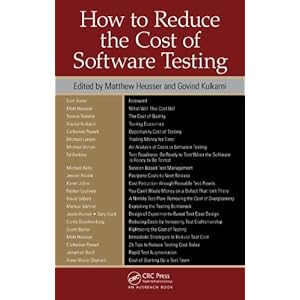
It is released! Book: How to reduce cost of software testing


This week this great book is released. (sept 15th 2011)

How to Reduce the Cost of Software Testing [Hardcover]

Not just another book
For me it is not just another book related to software testing. The editors Matthew Heusser and Govind Kulkarni gave me the opportunity to cooperate in their journey.

I think it is about a year ago an interesting thread started on Linkedin about cost of testing. This already made me more aware about this topic. There passed not much time Matt Heusser also contacted me as student of the “Miagi-Do School of Software Testing” and wrote me about Govind’s and his idea. He asked if I have some valuable contributions to make.

After explaining shortly to both that I was in the middle of some interesting exercise. Based on that exercise I might have some valuable contribution.

My short exercise
At that Time where I helped gaining information how we could help the business site of the organization by delivering software on defined dates while accepting in some cases functionality was not yet mature.
I observed that there was another need of information. I also noticed that which decision management made, it has impact on the test process.

When impact is involved, there are risks involved and to get more information about that risk you need to perform some activities. You can also introduce a risk yourselves: perhaps by not performing certain activities.

My idea is mainly based on controlling the test process on cost level by collecting information about the risks, the business need and how it work through the testing process. If risks are known you can start defining a strategy about how to continue: are you remain testing in the current phase and the costs are on that project? Or is there an option to shuffle the cost to another moment in time? Does it result in extra testing resources and cost or can you actually benefit from the accepted risks by management.

A year passed by
I never had experience writing a book or make a contribution to one. I had the dream of doing so. And more then a year ago I had the opportunity to participate. Amazing how such a process is evolving. I had great support from other co-authors and reviewers. They made me help to shape my story I believe is valuable. As I saw my story grow, I also had the opportunity to read the other chapters in the book. This strengthens me to believe we were working on something big. A book with combined knowledge and diversity in visions.

And now it is there! A book with great stories, sharing visions written and shared by testers I respect. If you want to know more about my contribution you might buy the book. If you have questions or need more information or share your experience you can contact me by mail.

Monday, January 31, 2011

Seminar: Are you innovating

Although this is not a correct translation it might make things more clear then call it "Innoveer jij mee!"

Today I attended a free seminar sponsored by Ordina with to great speakers: Gojko Adzic @gojkoadzic en Anko Tijman @Agiletesternl

The evening started with a long row to obtain "bad" coffee. With this start everything can only improve. And it did. Sure, there are always some things which are worse or could be better. Let me start with some small notes about the impression I gained. It is not the full story, just some snap shots and ideas.

Gojko's "Sleeping with the enemy".
As the chairmen mentioned, "Oh, no, not that again" It was not about testers and developers. Us and them. Hearing Gojko mentioned these words I immediately thought about the song from Pink Floyd Us and Them

Looking to the lyrics it can be so true. It also start with:
"Us and Them
And after all we're only ordinary men"


Gojko did not emphasize the idea of Us and Them. What I remembered was that he want to skip the functions. In teams we don't need functions, we perhaps need roles. We should get rid of our who's to blame culture.

He started with a great statement "Why are we[programmers] going to stop telling testers how to do their job? They know testing much better than we do!"
There is still some discussion possible if developers should test or testers should test. I think we should do both. I will come back to this later on.

In my opinion he used a very strong example. (Keep in mind that these are some pieces I remember from this evening. Therefore these are my interpretation and words).
A driving instructor is not telling you: you hit that car, and that car and that pedestrian. A driving instructor is teaching you how to drive.

A similar thing we testers should also do. Teach the developers how to test, participate. If they are able to do the testing for you. You gained time to do more important things.

Meanwhile @michelkraaij tweeted a statement @gojkoadzic, you keep making the distinction between developers and testers. Testers ARE developers!

We discussed this in the short break and Gojko marked that within a role there is also persons are involved. I translated that into a thought that personality is also important how a person can interact within his role.

So I polluted the twitter sphere with this idea as response:
ppl matters,personal value creates personality help define skills 2 form attitude able to act in a role

My idea with this statement is that it is easy to think that every one should be able to test or develop or do the same. Skills should be equal. Who does is doesn't matter. If people are involved we should respect them and human beings with a certain value. People differ and therefore have different personalities. I think the personality able a person to use their values under certain circumstances which will express their skills under those conditions. When it is noticed, people will respond on it and this will influence their attitude. And now based on the attitude, the presentation of the role which is needed will be express also. (don't shoot me for these thought, it are just ideas which seems reasonable to me, I did not read a book to support these ideas)

As promised, based on this concept it should not either be developers or testers who do the testing. Testing should be done by those who care about testing. If a developer cares about testing then let him test.

This was in other words also Gojko thought; he explained that when testers were involved quality reduced as they rely on the tester and no longer on their own skills/value (testing).

After all Gojko held a great presentation with hand drawn slides :) With perhaps a credo: "let developers help us to test so the testers can do other important things."

I think this can also be expressed by the words from Pink Floyd from the song mentioned earlier "And who'll deny that's what the fightings all about
Get out of the way, it's a busy day"


Agility in the waterfall?
After dinner Anko started the presentation he also held at Eurostar 2011 called "Building a Quality Driven Team". After some introduction he came up with some slides I initially thought he wants to bring us back into the waterfall. I can come up with argument I reject his story. I think he showed me some other ideas concepts. He made me think. Although his slides seemed to look like waterfall explanations. If I turn that concept around: He made me able to bring put arguments to the traditional project manager who relies on requirement, design build etc till it is good and supported by waterfalls ect.


The model Anko made for me was a model I could use to explain how certain phases of Agile testing fits in a V-model approach. If a PM fancies a V-model, why not use it to explain your thought. It can help to express that your ideas about Agile attitude and quality firs in his project also, only there are some other conditions. You might be able to build a bridge between different thoughts and gain some understanding. This might be a solid base for obtaining commitment.

Anko posed another statement about the emotional acceptance factor. I would translate that into an example I learned a few years ago.

I was on a project with the ideas of Agile and with a lot of commitment from business, team and project management. We tested together and did a great job. As well as developers and testers were able to tell on daily basis what they did and how the project was evolving and value was introduced. We were almost finished and one of the stakeholders complimented us with the result and made one final addition. I see you did a great job, I see that the quality is somehow made visible. The only thing I would ask you to do: Coach and support one of my key-users, make him test in his uncoventional way. if you are able to help him gain trust it would help me to sell it to the business.

This was not about not trusting our results. This was about some feeling based on emotions. This was emotional acceptance.

Hearing those words, I start remembering more of those examples. It is not explicitly written in books. It is there. And we should care.

There are more things I have remembered and should remember. After all, it was a valuable spend evening. Of such value I want to share it with you.
At the end I had some great conversations with other people and thanked Anko and Gojko.
While driving home I forgot to ask him if he had a copy of his book available and ready to sign, perhaps another time (@gojkoadzic you have my card :-) )
Monday, February 15, 2010

Test Automation by the book

Previous title was: "How TMap Next is used for automated testing" changed it into a proper title :)

Automate testing is hot. It has been hot since I work in the software testing business. It will be hot for a long time now. Often I hear arguments about automated test tools are shelf ware.


Sometimes I hear automated testing by the book is not possible. I might have formed an opinion that the Test Approach: TMap Next by Sogeti fails when it concerns automated testing.

When I think and talk about automated testing I think how to use tools and not how beautiful tools are. Sometimes you find another usage of items and methods. Recently I found someone using the Test method as written to automate his testing.

As you see, the book contains the method and it is used to automate his testing. Therefore the method is used for automated testing. In this example it was used to support the LSMW (Legacy System Migration Workbench) in SAP. An LSMW is a tool that supports the one-time or periodic transfer of data from a variety of sources without any programming. Only in this example it had to ran multiple times and therefore user interaction was needed to press the Enter button. As you see. The book/method is very useful to support in automated testing.

As you see the book is lying optimal on the "Enter-key". You might consider this as a steady firm tool. As some testers which are familiar with the "old"Tmap approach, we have been told to use it as a tool not as a goal. I think this is a good example to use a method as a tool.


To order this book as a tool you might take a look at: TMap next

Wednesday, December 24, 2008

Open source book: Software Testing Guide Book

Usually you see information in PDF format so it is sometimes hard to reuse. Accidentally I ran in a project were writers from over the world are creating a Software Testing Guide Book

Download the Open Office Document version here.

I have to admit I did not read the whole document and therefore I'm not able to say I support the content of this document. I think it is a project worth to mention.

Tuesday, December 23, 2008

Magazine: Professional Tester is Back!

One of the first magazine related to software testing I subscribed to was Professional Tester.
I enjoyed reading this magazine. Only after some while I didn't receive any issues.


I noticed that the website still exists so now and then I take a look at this site. to my surprise and joy I noticed the site has changed and there was a banner: Professional Tester is back!

Currently they didn't publish the editorial calendar. So I will keep monitoring this site waiting for the next issue.

Monday, December 22, 2008

Magazine: What is testing.com

During a short search on the internet I ran into this magazine: WhatIsTesting.com

The first issue was launched in April 2008. And after the free subscription I noticed that there are not yet other issues released.


I'm not quite sure what the value is of this magazine as on the same site there is a link to that other magazine: Experience Tester which already published their 4th issue.

Perhaps they combined forces; otherwise it might be another Magazine: What is testing.commagazine for us testers to get information from.

Sunday, September 14, 2008

Magazine: Software Test & Performance

During searching on the internet for information I ran into this magazine: Software Test & Performance. Though I somewere I already heard about it but forgot it over the time. Although the magazine contains quite some advertisements it also contains some good articles. And that is what it is all about.

This current issue can be downloaded from:
http://www.stpmag.com/retrieve/stp-0809.htm


This magazine can be ordered and a printed copy is send to your adress or you can download the magazine in PDF-format for FREE.


One of their good services is that they also made previous copies available for download.

Monday, September 8, 2008

SmarTEST a newer version


It is already some weeks ago I read a new book related to software testing called: SmarTEST. This book is written by Egbert Bouman from Valori. Though it is written in Dutch I think it is worth to translate it in English as well.

One of the strengths of this book that it is based on a business approach were 3 models are leading in the IPS-model (Information, Processes, Systems):
- For Information the model: IDQ (Information and Data Quality) is used
- For Processes: POQ (Processes and Organization)is used
- For Systems: ISO9126 is used.


Based on these 3 models their approach is explained. Some times as and addition to already known methods in the Netherlands Like: TMap, TestFrame, TestGoal and ISTQB. In other situations it continues as a new view to our business of software testing.

Another strength is the overview like stakeholders and possible acceptance criteria. Or like the difference between terminology between TMap, ISTQB and SmarTEST.

Though the business-view approach is the basis of the book in my opinion. They might have spent more attention towards the full integration of the quality models and their impact on software testing. Still a experienced software tester might be able to play with them their selves.
Does this make the book bad? I strongly say NO! It will be an addition to your collection as it gives you enough food to think about. Like: How many W-models are there and which W-model is good enough. What is your perception of using Agile as development method? Can other methods be a child of this method or are they all part of the Iterative (Evolutionary) approach?

Do we need more books related to software testing? I think so as our world is changing the approaches also changing. Do we need this book? If you are able to read Dutch books I recommend this book.

for more information see: their site: http://www.smartest.nl/
details:
Price: € 39,95
Book, paperback / 280 Pages/ Dutch
Academic Service / 2e edition/ Published 2008
ISBN-13: 9789012125970

Friday, March 28, 2008

Magazine: Testing Experience

Yesterday I ran in to the announcement of a new magazine for testing professionals. As they claim: "Testing Experience is the challenge of having a high quality magazine for professional testers made by and issued for people involved in testing. This magazine is free of charge and finances itself with adverts."

for more information see:Testing Experience

Friday, January 11, 2008

Opmerkingen mbt TMap next (DUTCH)

Jeroen: 4/21/2008: Changed this posting as it was mainly in Dutch and Im not sure it will help someone. If you still interested in my remarks you can always contact me.

Normally I'm trying to write this blog in English. Only this would exception on the rule and sometimes rules can be broken. :)
The list mentioned below I based what I found while reading TMap Next. There is no warranty if this list is correct. It is based on the ideas I had while reading the book. I created it while reading and at that time it was Dutch. I also don't know if it represents the same pages in English. this is the main reason why not starting to translate the whole list. Perhaps it helps some one in the nearby future.

Though the list is quite long, I DO like this book. It can give good help on test projects. In other words, if I didn't like the book I didn't spend time keeping a list for myself.

Here the list in Dutch: (here the list was in Dutch)